Audio Autopsy, 1972: Tampa's White Witch and the Karma of Capricorn
A little proggy & classic rock, with a dash of pop and hauntingly catchy melodies! So, what the hell were they doing on a label with the Allman Brothers, Grinderswitch, and the Marshall Tucker Band?
The entire White Witch debut album on YouTube:
“To bring good where there once was evil, to bring love where there once was hate, to bring wisdom where there once was ignorance: This is the power of White Witch.”…Pre-concert announcement at curtain
A radar blip…a tiny, little radar blip. Five guys and one album in 1972. Then, a rapid-fire personnel shuffle before Album #2 in 1974 (A Spiritual Greeting), which landed with an even deeper thud than their debut. Decades pass, and a couple haphazard attempts at reunions, and a band member’s untimely passing…
This is the story of the mysterious appearance and disappearance of White Witch, a Florida band who recorded a debut album that’s been beloved for decades by the few ears who have managed to hear it; they certainly got no help from radio!
Theirs is a story that, among other things, can point to how an artist’s label home can be more of a career anchor that sinks you than the hot air balloon that points you to the heights of stardom.
Out of Thin Air
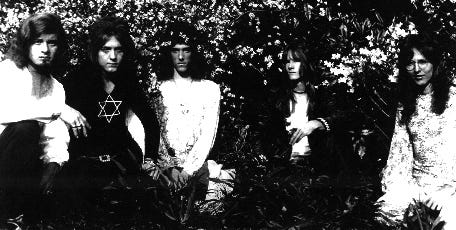
White Witch appeared, almost without warning, in 1971 in Tampa, Florida. They originally featured lead singer Ronn Goedert (who passed in July 2000), guitarist Buddy Richardson, keyboardist Hardin “Buddy” Pendergrass (passed in March 2003), drummer Bobby Shea, and bassist Beau Fisher.
In 1964, Pendergrass formed popular, 7-piece Tampa-area “horn band” called The Tropics. A 1966 International Battle of the Bands in Chicago ended up with The Tropics besting over 400 bands (including an early Chicago iteration and Tommy James and the Shondells) to earn a recording contract with Columbia Records (the previous year’s winner was the Young Rascals).
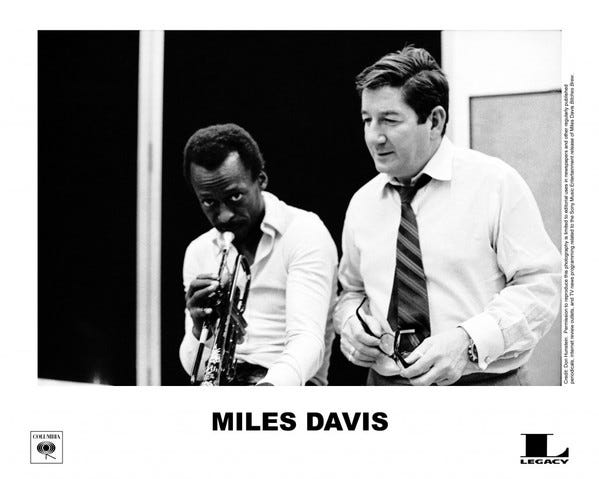
Their Columbia product was produced by longtime staff producer, Teo Macero (1957 to mid-’70s, shown above), known for his work with jazz legends, having produced Miles Davis’s landmark Bitches Brew album, as well as Dave Brubeck’s Time Out. He was also responsible for signing Charles Mingus, Thelonious Monk, and Charlie Byrd to the label.
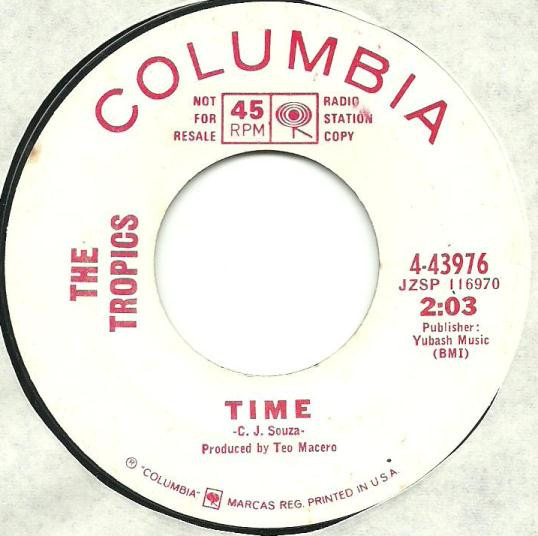
Despite the mid-’60s time-stamp for The Tropics, they were far less British Invasion pop than Seeds/Sonics garage-y roughness (think Lenny Kaye’s compilation, Nuggets), especially after new management suggested they lose the horn section.
From the late-’90s comes this revealing retrospective video, with song snippets, rare vintage photos, and interviews with Pendergrass and the other Tropics members, including eventual fellow White Witch-er, drummer, Bobby Shea:
From The Tropics to the Topic of Capricorn

Buddy Richardson (below, pictured on the cover of their debut album), lead guitarist and vocalist with White Witch, revealed to OrlandoJams.com, recently, how the band signed with their label:
“We were kind of ‘discovered.’ We played a show with Ted Nugent [still with Amboy Dukes, but certainly long before his Epic Records solo career, which began in ‘75]. I believe we may have even been called The Tropics that [1971] night. The guy that came and did the sound was named Terry Kane [who would co-found Miami’s TK Records label in the mid-’70s, with KC and the Sunshine Band as stars], and he was doing some work at the new studio they were putting together in Macon, Georgia for Capricorn Records.”
“This was all cosmic; we did not know who he was or that he would even be there. We played our set, and then he came up and was jut freaking out over our sound and our looks. Ronn (Goedert, vocalist) may have worn the make-up that night. [Kane] went back to Macon and said, ‘Hey, there’s this band !’
Capricorn’s partial artist roster, circa 1972-1974 (White Witch’s tenure on the label): Allman Bros., Marshall Tucker Band, Grinderswitch, Wet Willie, Bonnie Bramlett, Sea Level, Kitty Wells, Dixie Dregs, Delbert McClinton, Cowboy.
“Of course they [Capricorn] were all Allman Brothers-type music, and I did have my doubts about signing with that company but, nevertheless, they did invite us up there to do a demo session. It seems like we may have played ‘Help Me Lord,’ maybe ‘Don’t Close Your Mind,’ and probably ‘And I’m Leaving”; I can’t say for certain.”
Richardson continued: “They put us up in the central hotel in downtown Macon. They were still building the studio at the time and it was beautiful. We went in, set up our equipment, and played three songs live and I guess they taped them. I am not sure how
much time went by, but we eventually got a call and they said, ‘We would like to offer you a two-album contract,’ and that was it!
“So let me get this straight: You go off to a big label to sign a two-year contract and you have NO representation!?”
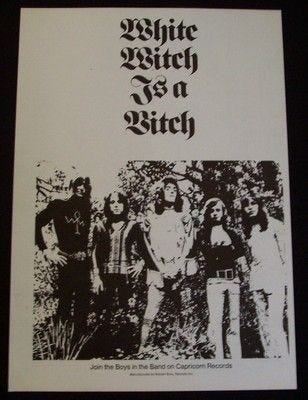
“Again, I remember when we were on our way to sign the contract, I was thinking, ‘You know, we have this show, we have this package [the image], we don’t need a manager. All we need is a record company and distribution. Up until now we had done everything ourselves.
“Many bands get record deals, and as they’re recording, they put everything together. They tell the bands, do this, don’t do that, but we already knew what we wanted to do. In fact, at the time we even had this beautiful faceless white witch oil painting that was painted for us by POPPY, a great artist.
“Now I am glad that we used our pictures on the cover, but at the time we really wanted to use that painting. We were that prepared is what I am saying! Capricorn didn't want us to use it, and I had my doubts about the label just because of
the ‘Southern Rock’ thing. I kind of felt like, ‘Why don’t we shop this before we sign?’
“We didn’t even give anyone else a chance to hear it! I felt like we should have taken some time out and think about it. What if something better comes along? Maybe some of the other guys felt like, ‘what if nothing else comes along?’”
Buddy’s interviewer, incredulous, asks: “So let me get this straight: You go off to a big label to sign a two-year contract and you have NO representation!?”
“No! Not at all, I guess we were so excited, you know? [Capricorn was distributed by] Warner Brothers. Everyone knew Warner Brothers! And also, [Capricorn, in Macon] was close to home.
“We [White Witch] really wanted to be ahead of our time, musically. We had a
Theremin [the eerie, weird-sounding instrument heard in the Beach Boys’ ‘Good Vibrations’] in the band back then.
“All of my bands would always put on some kind of show, with our clothing, hair styles, original and obscure cover songs. Even with White Witch, I would bet that we were the first band in the southern part of the U.S. that ever used a MOOG synthesizer. It used to freak everyone out.
“That is why it’s all over that first album. White Witch was very much a conceptual thing, and Ronn [Goedert, pronounced guh-DAIRT] and I were really into the spiritual thing.”
“I met Ronn [with sideburns, above] back when he had auditioned for our new band. I remember Ronn had a book called The Magic In Believing. In Ronn’s old band, The Rock’n’Roll Circus, he used to paint his face half black and half white. He was already into the theatrical thing!
“Anyway, I had a book called Helping Yourself with White Witchcraft, so Ronn and I were on that wavelength. I remember we used to both carry bags and in our
bags we had our cosmic books.
“We decided to do that with the music, making it a real cosmic thing. We were just into that cosmic ‘good vs. evil’. We had studied the Rosicrucians, Egyptian history, everything cosmic. I had a book called The Mystical Life Of Jesus. It goes into how He attained his great powers from the pyramids; we were really so into spiritual awareness.
“I feel that’s what [keyboardist, Buddy Pendergrass] wanted to do as well. I think
he was on the same page there. I did say that I want us to be a concept band and bring in the spiritual aspects of it, but we all had to be into it or it would have never happened.”
“Make no mistake,” Richardson continued, “White Witch was a well-thought-out thing; we wanted to say something. The lyrics, the image, the flash paper, the stage props, everything! It was fun!”

[Editor’s Note: I saw White Witch, live in concert, at Houston’s Music Hall, October 21, 1972, opening for Alice Cooper; I distinctly remember lead singer, Ronn Goedert, using flash paper on several well-timed occasions in the show. So much so that—as lead singer of my early-’70s, high-school-based cover band, Brimstone—I went to a local magic shop, bought some flash paper, and failed miserably in the one time I tried to use it!]
Related:
Richardson concludes: “Coming out of the south especially. Everywhere we went back then people were really freaked out: ‘What are you doing, we’re scared of you, we don’t know what you are doing!’ Once in New Orleans [1971, a year before their debut album was released], we took everyone in the bar, even the patrons, and we all went outside to the parking lot, and looked up to the stars, we were all holding hands and chanting.
“Now imagine what that was like, talking a bunch of strangers in a bar into doing that! They were spellbound.”
“Just as the moon reflects the light of the sun, so the mind reflects the light of the heart. There’s a being within the depth of the soul…latent, sleeping. Awake! Behold! Power so great, it cannot die”: Lyrics opening “Parabrahm Greeting.”


Just found this write up. Fantastic! Thank you very much. We are engulfaudio a high end audio store in Fairhope AL. I'm playing the album as we speak. They were my favorite in 9th grade and beyond. Again, thank you, much appreciated 👍
You saw them in '72? How cool is that! Thanks for the write-up on these guys, i learnt something new today.